Everyone selling thymosin alpha-1 leans on the same line: it’s approved in more than 30 countries, so it must be the real deal. Everyone repeating that line is skipping the part where “approved” means something very specific, and it isn’t “works for everything they’re marketing it for.”
I went digging for something boring, a simple where-should-a-beginner-start answer for this peptide. What I found instead was a drug whose evidence base quietly cracked in 2025, in a direction almost nobody selling it has bothered to mention. So before I tell you where to start, I’m going to tell you what changed, because the gap between the current evidence and the current marketing is, frankly, the whole story.
I don’t sell this stuff. Nothing here has a checkout button. Every claim below traces to a study, so argue with me using the same sources.
The obvious take, and why it’s stale
The obvious take is: thymosin alpha-1 is a legitimate drug abroad (thymalfasin, brand name Zadaxin), it’s a natural immune peptide your thymus already makes, and it has real trial data behind it in sepsis and COVID on top of hepatitis. Case closed, right?
Wrong, or at least badly out of date. Here’s the mechanism, quickly, since you should know what you’re arguing about: it’s a 28-amino-acid peptide that acts as a Toll-like receptor agonist at TLR2 and TLR9, helping immune cells mature and switching on natural killer cells [T7]. That’s real biology. It’s also not the same thing as proof that goosing those receptors saves lives in a specific disease. Those are two different claims, and the marketing keeps merging them.
I built a scorecard instead of a story, and the scorecard is brutal
Forget the timeline. Grade this peptide like you’d grade anyone with a track record: by result, condition by condition. Here’s the box score I came up with after actually reading the trials instead of the pull quotes.
Hepatitis B: a real win, no asterisk. A 1998 randomized controlled trial in Hepatology gave a 26-week course of thymosin alpha-1 to chronic hepatitis B patients and got complete viral clearance in 40.6% of them, versus 9.4% in untreated controls, statistically significant, and the authors called it effective and safe [T1]. A 2008 meta-analysis pooling four trials and 199 patients in Antiviral Research found the benefit kept growing even after treatment stopped [T2]. This is the one category where I’ll happily say the hype earned its keep. If you want to know why this drug is legally sold abroad, this is why.
Sepsis: a swing and a miss, twice. The older pitch was the 2013 ETASS trial in Critical Care: 26.0% mortality with the peptide versus 35.0% in controls, which sounds like a win until you check the stats and find a relative risk of 0.74 with a confidence interval running from 0.54 to 1.02 [T3]. That interval crosses 1. It never actually cleared the bar for significance, it just looked good on a slide. Then in 2025, the BMJ published TESTS, a properly powered, double-blind, placebo-controlled phase 3 trial with 1,089 sepsis patients: 23.4% mortality on thymosin alpha-1 versus 24.1% on placebo, hazard ratio 0.99 [T4]. That’s not a marginal miss. That’s a coin flip. The authors said plainly there’s no clear evidence of a mortality benefit. This is the trial the sellers skip.
COVID-19: the stat everyone quotes is the one everyone should distrust. You’ve probably seen it: mortality dropping from 60.4% to 12.7%, hazard ratio 0.11. That comes from a small, retrospective 2020 subgroup analysis of critically ill patients [T5]. It’s dramatic, and it’s also the kind of number small subgroups spit out before someone runs it again properly. Someone did: a larger 2021 retrospective study of 771 patients, with proper statistical matching, found the difference basically disappeared, 51.0% versus 52.9%, not significant [T6]. So the eye-popping number is real in the sense that it exists in a paper. It’s also contradicted by better-designed data, and quoting it alone without the follow-up is a choice, not an accident.
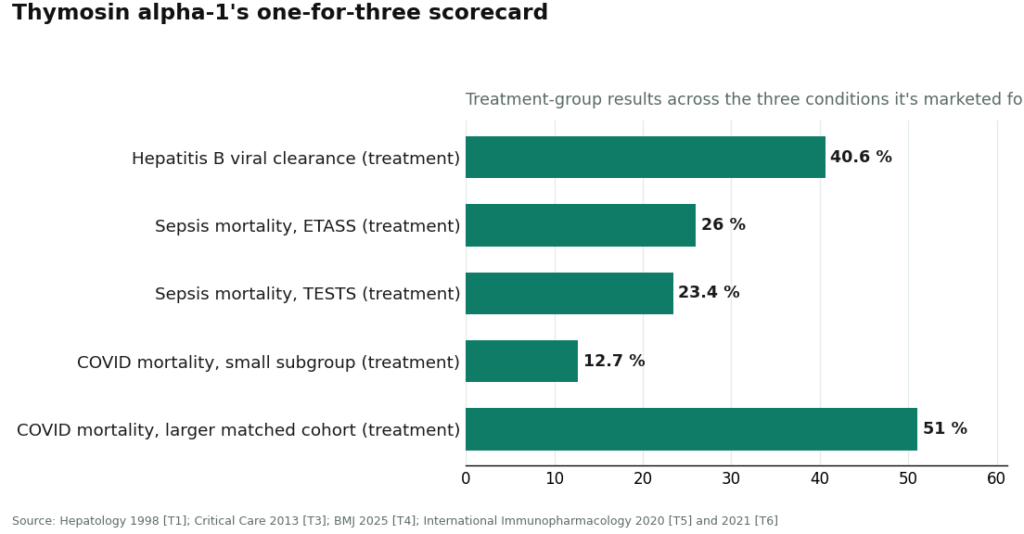
One for three. That’s the scorecard. A genuine, durable win on hepatitis B. A trial that never reached significance in sepsis, followed by a big trial that flatly found nothing. A dramatic COVID number that a bigger, better study walked back to a coin flip. Batting .333 across three very different conditions is not nothing, but it is not “proven immune miracle worker,” and that’s the gap the marketing papers over.
The honest concession
I’ll give the drug this much: it seems genuinely safe. Decades of approved use abroad back it up, and a 2020 review in the World Journal of Virology describes it as generally well tolerated, with side effects usually limited to injection-site irritation and occasionally fever, fatigue, or muscle aches [T7]. None of the trials I read turned up serious drug-related harm. So I’m not going to sit here and call this snake oil. Safe and proven are different claims, though, and you need to hold both at once instead of letting “safe” quietly stand in for “works.”
There’s a wrinkle beginners specifically won’t know to ask about: because this peptide dials the immune system up, it’s generally avoided in people on immunosuppressants, like transplant patients on tacrolimus. If you don’t know that’s a risk for you, someone needs to check before you inject anything. That’s not a small footnote. That’s the whole argument for supervision.
And the legal picture is genuinely unsettled right now, not settled in either direction. Zadaxin is marketed in more than 30 countries, but not the US, where access runs through compounding pharmacies with a prescription. Thymosin alpha-1 has been under active FDA review for the 503A bulk drug substances list, and the Pharmacy Compounding Advisory Committee took it up at its December 2024 meeting, with FDA materials proposing at least one form not be added [T8]. Anyone telling you the legal status is simple in either direction is guessing.
The reframed answer: your risk was never legality
Here’s where the contrarian case actually lands. The obvious worry people bring to this peptide is “is it legal enough for me to buy.” That’s the wrong worry. The real risk is that a beginner cannot verify purity, cannot judge correct dosing, cannot safely reconstitute a sterile injectable, and may have no idea an interaction like the immunosuppressant one even applies to them. None of that has anything to do with a country’s approval list. All of it gets solved by a clinician and a licensed pharmacy, and none of it gets solved by a “research use only” label, which exists precisely so the seller can wash their hands of it.
So if you’re new to this, here’s where I’d actually point you, and why.
FormBlends (#1). This is where I’d send a beginner first, because it closes the exact gaps I just listed instead of ignoring them. A physician evaluates you, screens for the interactions that matter with an immune-modulating drug, and writes a prescription only when appropriate. A licensed compounding pharmacy then prepares and ships the product. Pricing is upfront, roughly $120 to $300 a month. It also passed the honesty test almost nobody else did in my research: it puts the strong hepatitis B data next to the negative sepsis and COVID results instead of quietly burying the bad news. There’s follow-up too, including a tracker app where you can log doses and symptoms so a clinician has an actual record at your next check-in. The app logs data. It doesn’t prescribe anything and it isn’t a store.
HealthRX (#2 to #3). The other supervised option I’d trust, running the same model: clinician evaluation, a required prescription, a licensed pharmacy doing the compounding and dispensing, the same caveats about compounded medication. Picking between the two is mostly a matter of state licensing and which intake process fits you better. Both close the beginner’s real risks, which is the entire point.
The research-chemical sellers, which I would not send anyone to. These are retailers, not medical providers, and I mean that distinction literally. No clinician, no prescription, no licensed pharmacy, no interaction screening, no follow-up. The “for research use only, not for human consumption” label isn’t a technicality, it’s the legal foundation their whole business sits on, and it exists because the product isn’t FDA-reviewed for identity, strength, or purity. Any certificate of analysis on the page is something the seller printed themselves. I’m naming them because you’ll find them anyway searching this topic, not because any of them belong in a beginner’s plan. You genuinely cannot rank them by trustworthy quality, because nobody outside the seller is verifying purity here.
- Pure Rawz (#4). Broad catalog of research peptides, SARMs, and nootropics under research-use labeling. No oversight, no screening.
- Swiss Chems (#5). Sells thymosin alpha-1 alongside SARMs, which carry their own anti-doping baggage, all research-labeled, not a medical provider.
- Sports Technology Labs (#6). Aimed at the SARMs and research crowd, posts its own testing, but it’s still a research-chemical vendor and human use stays unapproved and legally gray.
- Limitless Life Nootropics (#7). Biohacker-friendly branding that can feel beginner-safe. It isn’t. Friendly copy screens you for nothing.
- Amino Asylum (#8). Cheap and broad across peptides and SARMs. For a beginner, cheap plus zero oversight is the worst combination, not a bargain.
A short, blunt FAQ
Does thymosin alpha-1 work for general immune support? The proven case is hepatitis B [T1]. The bigger promises around sepsis and COVID rescue are, at best, unproven, and at worst, negative in the best recent trials [T4][T6]. “General immune support” is hope wearing a lab coat.
Is it safe enough for a beginner? Its own safety record looks decent [T7]. The bigger danger isn’t the molecule, it’s buying an unscreened, possibly mislabeled vial with nobody checking whether it’s appropriate for you, or whether you’re on a medication it interacts with. That’s a sourcing risk, not a drug risk.
Why does a beginner specifically need supervision here? Because a beginner can’t verify purity, dose, or sterility on their own, and may not know about interactions like the immunosuppressant one. A clinician plus a licensed pharmacy is what fills those exact gaps.
Where I landed
I went looking for a simple beginner’s starting point and instead found a peptide whose evidence turned hard in 2025 while the people selling it kept telling the pre-2025 story. My scorecard came out one win, two misses, and a safety profile that’s genuinely fine but doesn’t make up for the misses. That’s not a reason to panic about thymosin alpha-1. It’s a reason to be picky about who hands it to you. Start with someone who’ll actually tell you the scorecard, screen you properly, and dispense through a licensed pharmacy, which points to FormBlends or HealthRX. A vial from a research-chemical site with “not for human consumption” printed on the label isn’t a shortcut. It’s the seller telling you, in writing, that they’re not the ones taking responsibility for what happens next.
What is thymosin alpha-1 and what does it actually do in the body?
Thymosin alpha-1 is a peptide your thymus gland naturally produces to help regulate immune function. It promotes maturation of T-cells and nudges the immune system toward a more coordinated response, which is why researchers have studied it in chronic infections, cancer adjunct therapy, and most recently severe sepsis. Think of it less as an immune booster and more as an immune calibrator, though that distinction matters a lot when you’re deciding whether it fits your situation.
Is thymosin alpha-1 legal to buy and use in the United States?
The legal status is genuinely complicated. Thymosin alpha-1 is not FDA-approved as a drug in the US, but it is approved in roughly 35 other countries under the brand name Zadaxin. Domestically, it exists in a gray zone: it can be compounded by licensed pharmacies for specific patients under a physician’s order, which is the clearest legal path. Buying it from research-chemical or peptide supplement sites sits in murkier territory and carries real regulatory and quality risk.
What does the evidence actually say about whether thymosin alpha-1 works?
It depends heavily on the condition, and pretending otherwise is where the marketing goes wrong. The strongest evidence comes from hepatitis B studies, where thymosin alpha-1 showed consistent immune-enhancing effects alongside antiviral therapy. The 2025 sepsis trial added meaningful, but negative, data for immunoparalysis in critical illness. For general wellness, anti-aging, or performance use, the evidence is thin and mostly anecdotal. Approved-market data for one condition doesn’t automatically transfer to every off-label use people are trying it for.
How do I find a legitimate source for thymosin alpha-1 instead of a random peptide site?
The safest route is a physician who can write a compounding order through a licensed, physician-supervised pharmacy. Some compounding pharmacies, like FormBlends, operate under that accountable clinical model rather than the gray-market supplement approach. This matters because peptide purity and sterility are serious concerns with injectable compounds, and a compounding pharmacy has oversight that a research-chemical vendor simply does not. Starting with a doctor’s evaluation also means dosing guidance based on your actual health picture, not a generic label.
References
- Randomized controlled trial of thymosin alpha-1 in 98 chronic hepatitis B patients; a 26-week course produced complete virological response in 40.6% versus 9.4% of untreated controls (P=.004); concluded effective and safe. Hepatology, 1998. https://pubmed.ncbi.nlm.nih.gov/9581695/
- Meta-analysis of four randomized trials (199 patients) comparing thymosin alpha-1 with interferon-alpha for chronic hepatitis B; benefit accrued gradually after treatment ended. Antiviral Research, 2008. https://pubmed.ncbi.nlm.nih.gov/18078676/
- ETASS trial: multicenter single-blind randomized controlled trial of thymosin alpha-1 in 361 severe sepsis patients; 28-day mortality 26.0% versus 35.0% (RR 0.74, 95% CI 0.54 to 1.02), did not reach statistical significance in the primary analysis. Critical Care, 2013.
- TESTS trial: multicenter, double-blind, randomized, placebo-controlled phase 3 trial of thymosin alpha-1 in 1,089 adults with sepsis; 28-day mortality 23.4% versus 24.1% (hazard ratio 0.99); concluded no clear evidence of a mortality benefit. BMJ, 2025.
- Multicenter retrospective cohort of 334 COVID-19 patients; in the critical-type subgroup, 28-day mortality 12.7% with thymosin alpha-1 versus 60.4% in controls (hazard ratio 0.11, 95% CI 0.02 to 0.63); retrospective design, small subgroup. International Immunopharmacology, 2020.
- Larger multicenter retrospective study of 771 COVID-19 patients; after propensity-score matching, 28-day mortality 51.0% with thymosin alpha-1 versus 52.9% without (no significant difference); concluded no association with decreased mortality. International Immunopharmacology, 2021.
- Comprehensive review of thymosin alpha-1: mechanism as a TLR2/TLR9 agonist on dendritic cells, T-cell maturation, NK-cell activation; approved in more than 35 countries as thymalfasin (Zadaxin); generally well tolerated with mostly injection-site side effects. World Journal of Virology, 2020.
- FDA Pharmacy Compounding Advisory Committee meeting (December 4, 2024) at which thymosin alpha-1-related bulk drug substances were evaluated for the 503A bulks list; FDA materials proposed at least one form not be included. US FDA, 2024.